
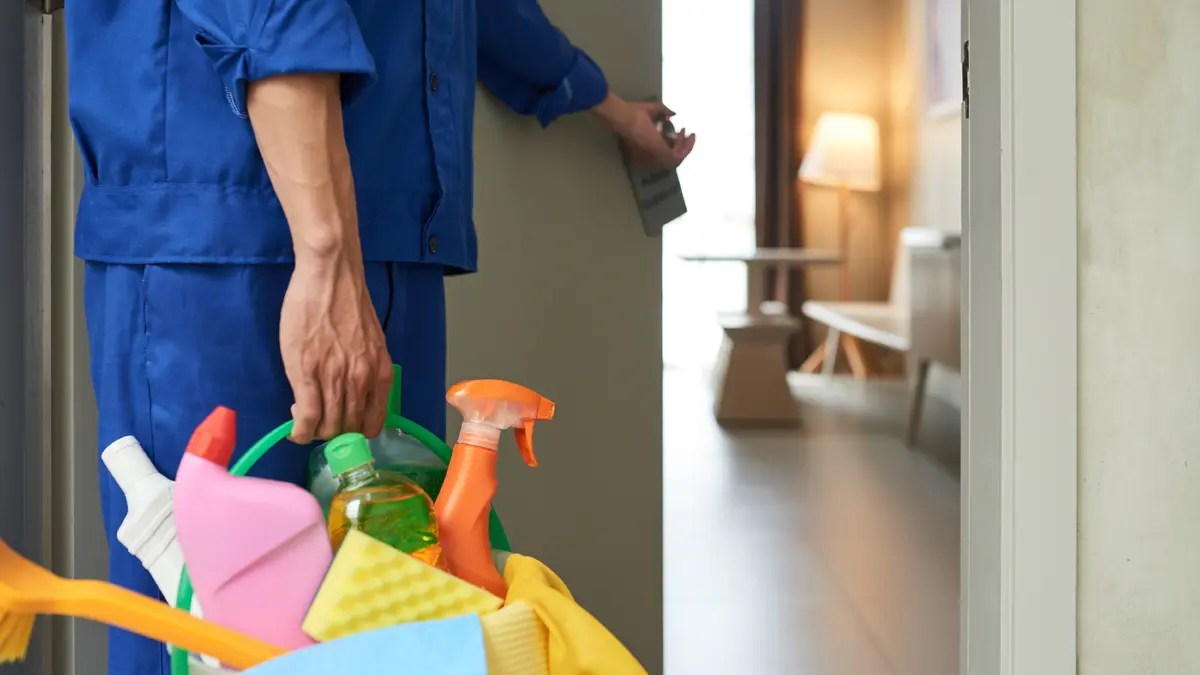
In the Athens short-term rental (STR) market, the ultimate operational test for hosts is the critical 4-hour (240-minute) time crunch between check-out at 11:00 AM and check-in at 3:00 PM. Managing guest turnover cleaning (Same-Day Turnover / Καθαρισμός Ίδιας Μέρας) flawlessly within this narrow window requires a total time-engineering approach.
This guide focuses on the operational timing and logistical dimensions of turnovers. Methodology: cleaning standards. Legal liability: regulatory compliance. Biological rejection criteria: pest control guide.
1. What is the Critical Path Method?
To manage same-day arrival/departure operations without errors, all tasks must be broken down according to a sequential order where any delay directly postpones the next guest's check-in—this is the Critical Path (Κρίσιμη Διαδρομή). Tasks on the Critical Path cannot be delayed; other tasks are flexible and can be compressed if necessary.
2. The 240-Minute Chronological Timeline
For a standard 2-bedroom, 1-bathroom Athenian polykatoikia apartment, the operational schedule should be structured chronologically as follows:
| Real Time | Elapsed (min) | Operational Stage | Processes to Implement | Critical Path |
|---|---|---|---|---|
| 11:00 – 11:15 | 0 – 15 | Entry & initial assessment | Immediate damage assessment, photo documentation, smart lock verification, initial check of safety equipment | Critical |
| 11:15 – 11:30 | 15 – 30 | Linen stripping & waste | Stripping dirty linens/towels, trash collection, emptying the refrigerator, dispatching dirty laundry | Critical |
| 11:30 – 12:30 | 30 – 90 | Wet area sanitation | Deep cleaning of bathroom/kitchen, removing limescale stains, disinfecting countertops | Flexible / compressible |
| 12:30 – 13:30 | 90 – 150 | Dry area details | High-touch points, vacuuming, window wiping, AC filters | Flexible / compressible |
| 13:30 – 14:00 | 150 – 180 | Floor ergonomics | Sweeping, static dusting, deep floor mopping | Flexible / compressible |
| 14:00 – 14:30 | 180 – 210 | Bed setup & staging | Fresh linen and towel presentation, bathroom consumables stocking | Critical |
| 14:30 – 14:45 | 210 – 225 | Quality Assurance (QC) | Digital checklist, proof photos, technical verification | Critical |
| 14:45 – 15:00 | 225 – 240 | Exit & lockdown | Trash removal, window locking, smart lock code reset, odor neutralization | Critical |
Parallel Processing
To compress time, overlapping parallel protocols should be implemented instead of sequential cleaning:
- Damage and Stripping Cycle: While staff scan the property for rule violations (smoking, pets) or damage, they should simultaneously strip and bag bed sheets; this prevents dust and hair strands from dispersing into the air.
- Chemical Dwell Time: As soon as stripping is complete, limescale remover should be sprayed on the toilet, shower glass, and sinks, leaving the chemicals to dwell for 20 minutes. Meanwhile, staff dust dry areas, cutting manual scrubbing time in half.
3. The Laundry Bottleneck: The 280-Minute Equation
Attempting to wash and dry dirty linens inside the apartment during that narrow 4-hour window is physically impossible and is the number one cause of delayed check-in complaints.
The processing time for a standard 8 kg load of cotton linens and towels in residential machines is:
- Washing (60°C hygiene cycle): ~90 minutes
- Transfer and filter cleaning: ~10 minutes
- Drying (cupboard dry at high ambient temperature): ~150 minutes
- Hand ironing (for luxury presentation): ~30 minutes
- Total: 90 + 10 + 150 + 30 = 280 minutes (4.67 hours)
T_laundry (280 min) > T_window (240 min) — an in-apartment laundry cycle within the same-day window is physically impossible. The solution is to switch to a 4-Par linen inventory system and outsource the laundry operation to industrial providers.
4. Algorithmic and Legal Risks of Late Check-Outs
Airbnb's algorithm uses guest experience as the primary fuel for search visibility. A failure in a same-day turnover triggers a chain-reaction disaster.
Algorithmic Risk Chain
- Late Check-Out / Rushed Turnover: A guest checking out late delays staff; a rushed cleaning overlooks hair strands or dust, directly resulting in a 4-star cleanliness rating. Dropping below a 4.90 cleanliness score leads to the instant loss of the Guest Favorite badge, a 40% reduction in search visibility, and a 2x to 3x crash in bookings.
- Mandatory Cancellation Penalty: If you are forced to cancel the next guest because of an overstaying guest, the platform fines the host up to 50% of the reservation value, locks the calendar, and instantly revokes Superhost status.
The Host's Legal Shield
Airbnb Terms of Service (Article 8.2.2) defines guests who remain on the property without the host's permission as «Ekisprothesmi Diamoni» (Overstay). This rule gives the host the right to make the guest leave in accordance with local laws and charge an overstay fee of up to 2x the nightly listing rate.
Under the Greek legal framework, short-term rental guests do not hold standard tenant rights. If the guest does not vacate the property by 12:00 PM, the host has the legal right to enter the property, report the situation to the platform, and request emergency police assistance on the grounds of criminal trespass.
5. Neighborhood-Based Logistical Time Buffers
Athens' historic street layout and narrow polykatoikia architecture restrict vehicle mobilization, adding logistical burdens to the 240-minute turnover window. A different time buffer must be added for each neighborhood:
| Neighborhood | Logistical Challenge | Additional Buffer Time |
|---|---|---|
| Plaka (Πλάκα) | Historic pedestrianized areas, strict vehicle access bans, steep stairs. Logistical vehicles cannot enter; staff must carry textile bags 400 meters by hand. | +45 minutes |
| Kolonaki (Κολωνάκι) | Steep inclines, narrow one-way streets, parking scarcity. Double-parking instantly locks traffic. | +30 minutes |
| Exarchia (Εξάρχεια) | Frequent road closures, steep hills, narrow sidewalks, high pedestrian density. | +20 minutes |
| Koukaki (Κουκάκι) | Dense inner-neighborhood parking, double-parked delivery scooters. Just searching for a spot wastes 15 minutes. | +15 minutes |
Vertical architectural barrier: Classic Athens polykatoikia buildings built between 1950 and 1980 either lack elevators or have an elevator capacity below 150 kg. Carrying massive textile hampers up to the 4th or 5th floor via narrow marble stairs physically slows down the staff's cleaning speed.
6. Municipal Parking Control System (Σ.Ε.Σ.) and Fines
The Athens Municipal Police (Δημοτική Αστυνομία) strictly monitors roadside parking spaces via color-coded lines:
| Parking Zone Type | Usage Rule | Violation Fine |
|---|---|---|
| Blue lines (P-70) | Reserved exclusively for permanent residents of that neighborhood | 80 € + risk of license plate removal |
| White lines (P-69) | Visitors for a maximum of 3 hours (paid via myAthensPass) | 20 € |
| Yellow lines (P-40) | Commercial loading and emergencies only | 80 € + vehicle towing |
Strategic solution: To eliminate the risk of fines and confiscated license plates, logistics coordinators must secure fixed corporate agreements with private indoor parking garages in the center of Plaka and Kolonaki, ranging between 13 € and 25 € per day.
7. Statutory Quiet Hours Compliance
In Greece, under Police General Order 3/1996 (Αστυνομική Διάταξη 3/1996), Statutory Quiet Hours (Ώρες Κοινής Ησυχίας) are strictly enforced:
- Summer period (April 1 – September 30): 15:00 – 17:30 and 23:00 – 07:00.
- Winter period (October 1 – March 31): 15:30 – 17:30 and 22:00 – 07:30.
Since the same-day rental window ends exactly at 3:00 PM (15:00), the slightest operational slip will cause the cleaning crew to work during legally restricted quiet hours. Violating quiet hours under Article 12 of Law 1481/1984 is a criminal offense. If a neighbor calls the Greek Police:
- Risk of detention with a potential prison sentence of up to 5 months.
- AMA license revocation: Consecutive police reports lead to the revocation of the property's AMA registration number. Because the moratorium is active, a revoked AMA can never be recovered.
For full legal details on these penalties, please refer to our regulatory compliance guide.
Operational Noise Control Protocol
- 14:30 «No-Noise» deadline: All loud tasks such as vacuuming, deep floor scrubbing, running washing machines, or moving heavy furniture must be completed by 2:30 PM (14:30) at the latest.
- Silent phase (14:30 – 15:00): The final 30 minutes of the operation must be reserved strictly for quiet, manual tasks such as bed making, arranging toiletries, dusting, and photo inspections.
- Acoustic isolation: Industrial felt pads must be attached to all chair and table legs to eliminate scraping sounds on common marble and tile floors.
- Manager hotline: Establishing direct communication with the building manager (διαχειριστής) to resolve crises internally before they escalate to the police.
8. Emergency Preparedness Kit (Emergency Kit)
In Athens, cleaning crews must always enter a property equipped with a fully stocked Emergency Kit (Emergency Staging Kit / Κιτ Έκτακτης Ανάγκης) to handle locked supply closets, missing consumables, or last-minute stains:
- Linen & bath: 2 complete sets of fitted sheets and duvet covers; a luxury towel set consisting of 4 bath towels, 4 hand towels, and 2 bath mats (550+ GSM). This allows for an immediate bypass of unwashed or stained linens in the apartment.
- Chemicals: Industrial-grade limescale and grease removers to make faucet scale deposits shine in seconds without scrubbing.
- Personal care: 6 units each of shampoo, conditioner, shower gel, and soap to line up guest amenities in a standardized presentation.
- Regulatory compliance equipment: A spare Residual Current Device (RCD) fuse; a 6 kg dry powder fire extinguisher for every 100 m²; smoke detectors with backup batteries; a sealed first aid kit; an emergency exit diagram and emergency contact numbers list.
9. API-Integrated Automation vs. Unsecure iCal
Attempting to manage booking schedules manually via WhatsApp or with standard iCal links is an operational gamble for larger portfolios:
| Operational Feature | Standard iCal Synchronization | Direct PMS-to-Operations API |
|---|---|---|
| Sync delay | High (risk of 2–4 hour lag) | Instant (real-time webhook) |
| Detecting calendar blocks | Weak (mistakes owner blocks for bookings) | Strong (differentiates blocks) |
| Guest count data transfer | None (must be written manually) | Automatic (guides linen staging) |
| Smart lock integration | None (entry code sent manually) | Fully automated (custom code for 11:00–15:00) |
| Verification | Merely a «cleaning done» message | Photo-stamped, GPS-verified checklist |
iCal feeds function via a «pull» mechanism, which causes last-minute, back-to-back reservations to be completely missed. For PMS and remote automation stack details, review our remote operations guide.
Strategic Operational Summary
Surviving in the strictly regulated 2026 Athens short-term rental market using amateur hosting methods is impossible:
- Apply the Critical Path methodology: Divide the 240-minute timeline into critical and flexible tasks; compress time using parallel processes.
- End in-apartment laundry cycles: Switch to a 4-Par inventory system and outsource core laundry operations to industrial laundries.
- Protect the legal buffer: Integrate overstay (late check-out) fines into your house rules to guarantee an 11:00 AM check-out.
- Account for logistical buffers: Include neighborhood buffers into your operational planning—such as +45 mins for Plaka and +30 mins for Kolonaki—and establish private indoor parking agreements.
- Enforce the noise cutoff deadline: Ensure absolute compliance with statutory quiet hours using the 14:30 «No-Noise» rule to protect your active AMA license.
NextStay Cleaning implements Critical Path-focused same-day turnover and emergency kit protocols for Athens STR portfolios. For scope and 2026 pricing, view our post-guest cleaning services or submit your unit details via Get a Quote.
Frequently asked questions
How much time is available for same-day turnover in Athens?
With check-out at 11:00 and check-in at 15:00, there is a 240-minute (4-hour) window. The Critical Path Method separates tasks into critical and flexible to optimize this time.
How does the Critical Path Method work in turnover?
Non-delayable tasks (linen removal, bed setup, QC) run sequentially; flexible tasks (dusting, vacuuming) run in parallel, optimizing the 240-minute window.
What happens if a guest checks out late?
Overstay penalties must be in house rules. Late checkout delays the next guest and triggers an algorithmic complaint chain. 11:00 checkout is enforced via smart lock.
Why prefer API integration over iCal?
iCal has 2-4 hour sync delays and misses back-to-back reservations. API provides real-time webhooks, smart lock automation, and photo-stamped verification.